sábado, 21 de noviembre de 2009

Programming Languages


Visual Basic Programming

Programming in Visual Basic is an agile and simple way to create applications for Microsoft Windows.
The programming language in Visual Basic provides all the necessary tools for rapid application development.

We could define programming in Visual Basic as the method used to develop graphical user interface.
With programming in Visual Basic you can develop almost any program you can imagine.

In addition to ActiveX technology, Visual Basic provides a tool for creating unlimited applications in the network.

Programming in Visual Basic allows to quickly build Windows applications. It is not necessary to know other programming languages to program in Visual Basic podersaber.

Programming in Visual Basic is a simple way to create applications besides language offers a number of tools to simplify this work, including projects, templates, forms, objects, custom controls, add-ins and a database manager.

Version 6.0 of Visual Basic programming is specially designed for the Internet. Using executable ActiveX controls operate like Visual Basic application is independent and through which they can access Internet Explorer.

Key features of programming in Visual Basic 6.0:

-The ability to access data from the database, client / server and scalable applications such as Microsoft SQL Server.
-ActiveX Technology
-ActiveX Controls
-Internet programming, web servers, DHTML, etc. ..
-Creating. Exe files, allowing circulated plication with great freedom.


Creado por Geraldine Avila

Database management systems

Database management systems

A database management system (DBMS) consists of software that organizes the storage of data. A DBMS controls the creation, maintenance, and use of the database storage structures of social organizations and of their users. It allows organizations to place control of organization wide database development in the hands of Database Administrators (DBAs) and other specialists. In large systems, a DBMS allows users and other softwares to store and retrieve data in a structured way.

Database management systems are usually categorized according to the database model that they support, such as the network, relational or object model. The model tends to determine the query languages that are available to access the database. One commonly used query language for the relational database is SQL, although SQL syntax and function can vary from one DBMS to another. A common query language for the object database is OQL, although not all vendors of object databases implement this, majority of them do implement this method. A great deal of the internal engineering of a DBMS is independent of the data model, and is concerned with managing factors such as performance, concurrency, integrity, and recovery from hardware failures. In these areas there are large differences between the products.

A relational database management system (RDBMS) implements features of the relational model. In this context, Date's "Information Principle" states: "the entire information content of the database is represented in one and only one way. Namely as explicit values in column positions (attributes) and rows in relations (tuples). Therefore, there are no explicit pointers between related tables." This contrasts with the object database management system (ODBMS), which does store explicit pointers between related types.

STRUCTURED PROGRAMMING


STRUCTURED PROGRAMMING.


Structured Programming: A technique in which the structure of a program the writing of its parts is made as clearly as possible through the use of three logical structures of control:

Sequence; a sequence of two or more simple operations.

Selection: Conditional Split one or more transactions.

Interaction: Repeating an operation while a condition is met.


These three types of logical structures of control can be combined to produce programs that handle all information processing task.

A structured program cosists of segments, which may be constituted by a few instructions or a page or more coding. Each segment has only one entrance ande one exit these segments, assuming you do not have infinite loops and have never run instructions are called programs themselves. When several programs themselves are combined using the three basic control structures mentioned above, the outcome is also own program.

Structured programming is based on the structure theorem, which states that any proper program (a program with one entrance and one exit only) is equivalent to a program that contains only the logical structures mentioned above.

An important feature is a structured program that can be read sequentially, from beginning to end without losing the continuity of the task that the program meets opposite of what occurs with other programming styles.

This is important because it is much easier to understand fully the work they perform a particular funtion, if all instructions that affect is action are physically close and enclosed by a block. The ease of reading, from beginning to end, is a consequence of using only three control structures and to eliminate diversion instruction control flow, except in very special circumstances such as simulation of a logical structure in language control programming that does not possess.


Creado por Geraldine Avila

viernes, 20 de noviembre de 2009

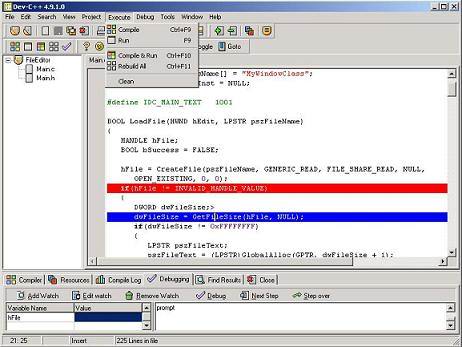
Programming Language(language c + +):

C + + is a programming language designed in the mid-1980s by Bjarne Stroustrup. The intention of its creation was to extend the successful C programming language with mechanisms that allow manipulation of objects.

Any program in C + + should have the main () (unless specified at compile time another entry point, which actually is the function that has the main ())

The main function must have one of the following prototypes:int main ()int main (int argc, char ** argv)The first is the omission of a program that receives no parameters or arguments. The second form takes two arguments: argc, a number that describes the number of arguments the program (including program name itself), and argv, a pointer to an array of pointers to argc elements, where the element argv [i] represents the i-th argument given to the program.The return type of main is int. At the end of the main function, must include the return value (for example, return 0;, although the standard provides only two possible return values: EXIT_SUCCESS and EXIT_ERROR defined in cstddef file), or leave through the exit function . Alternatively you can be left blank, in which case the compiler is responsible for adding the proper output.
luisa nuñez

What is Systems Engineering?

Systems Engineering is the application of mathematical and physical sciences to develop systems that use economically the materials and forces of nature for the benefit of mankind.A particularly full-definition, dating from 1974 - offers us the military standard U.S. Air Force engineering management. Systems Engineering is the application of scientific and engineering efforts to:

(1) transform an operational need into a description of system performance parameters and system configuration through the use of an iterative process of definition, synthesis, analysis, design, testing and evaluation.


(2) integrate related technical parameters to ensure compatibility of all functional and program interfaces in order to optimize the identification and total system design.


(3) integrating factors of reliability, maintainability, safety, survivability, human and others in the total engineering effort to meet cost objectives, planning and technical performance.


luisa nuñez

photos in class


in English class two with the teacher.
Luisa nuñez
20 de noviembre del 2009 a las 09:30pm